El Niño: A natural cycle in a world we made hotter
How one climate pattern begins in the pacific, why its consequences are felt far beyond it, and what it reveals about a warming world.
Somewhere across the tropical Pacific Ocean, thousands of kilometres away from most of us, the water begins to change. Nothing dramatic happens at first. No alarm goes off, and no visible lines tell us that something different has begun. The water simply becomes warmer than it should be, the winds that normally push it across the Pacific begin to weaken, and one of the largest natural climate systems on Earth slowly starts to rearranging itself.
Months later, a farmer in southern Africa may look at a field waiting for rain that never arrived. A family in Peru may watch as they enter their home after unusually intense rainfall. Somewhere in Indonesia, forests can become dry enough to burn. On another continent, food production may fall, and prices may start rising.
Some of these people will never see the Pacific Ocean. And, for me, that is probably what fascinates me most about El Niño. The phenomenon begins in the Pacific, but its consequences can travel around the planet.
So, what actually is El Niño?
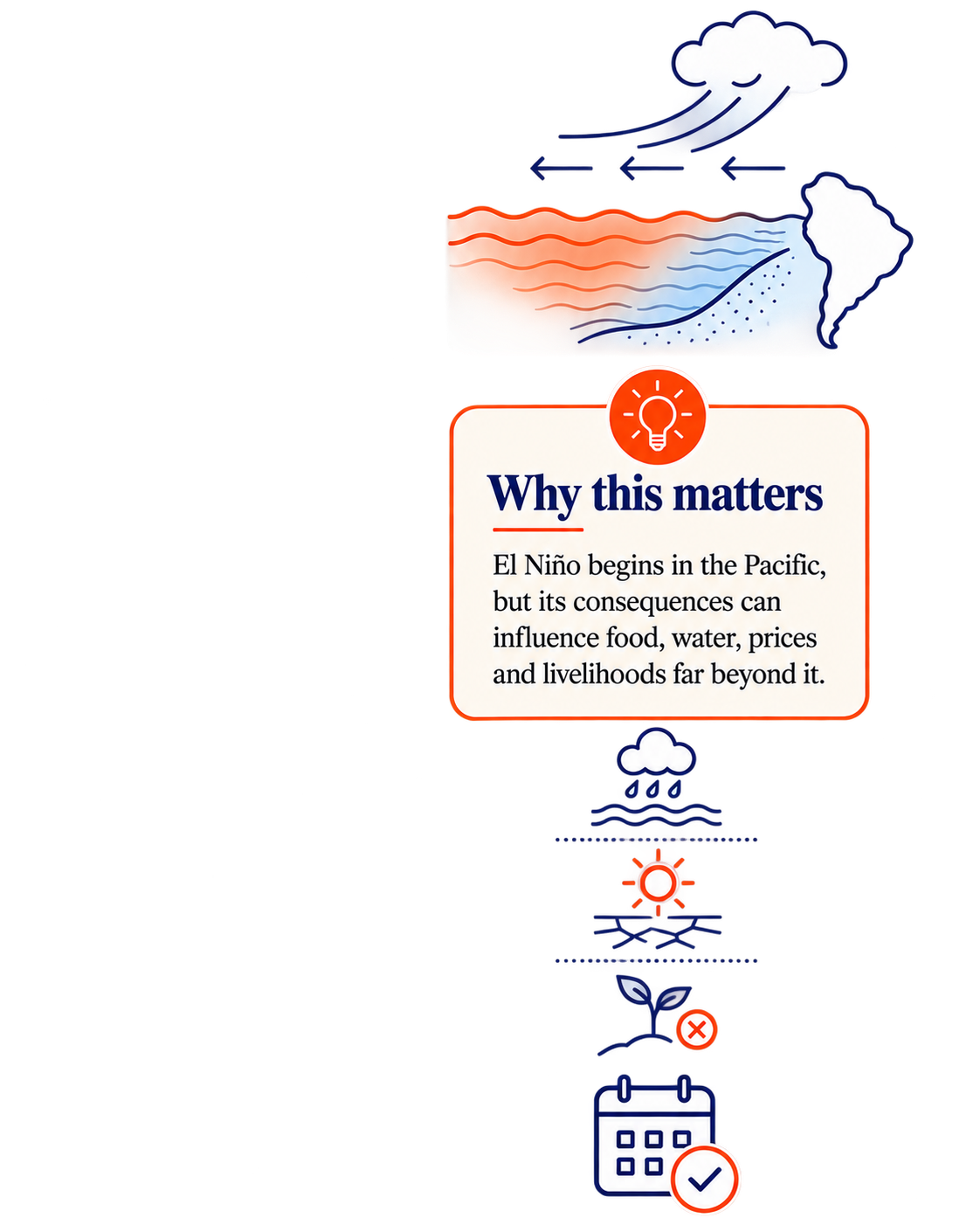
Under normal conditions, trade winds blow east to west across the tropical Pacific, pushing warm surface water towards Asia and Australia. Near the western coast of South America, particularly Peru and Ecuador, colder water rises from deeper parts of the ocean towards the surface. This process is called upwelling, and it carries nutrients that support marine ecosystems and some of the world’s most important fisheries.
During El Niño, this balance changes. The trade winds weaken, warm water spreads eastwards, and the normal upwelling of colder water becomes weaker. The central and eastern tropical Pacific become unusually warm.
Afterward, the atmosphere reacts. Rainfall patterns change, atmospheric circulation shifts, and jet streams can move, influencing weather thousands of kilometres away. Scientists call the wider system ENSO (The El Niño-Southern Oscillation). El Niño is its warm phase, while La Niña is the colder phase.
According to NOAA, El Niño events generally occur every two to seven years and normally last around nine to twelve months, although some continue for longer. As of late August 2026, El Niño is strengthening. NOAA’s assessment from 13 August gives a greater than 90% probability of a very strong El Niño during the Northern Hemisphere autumn and winter of 2026-27. The World Meteorological Organisation has also warned that the event is expected to intensify and influence temperature and rainfall patterns across large parts of the world.
So while El Niño begins in one particular ocean, what follows can become a global story.
Of course, the sensation of El Niño does not mean the same thing everywhere. Parts of Peru and Ecuador may experience unusually heavy rainfall, flooding and landslides, while warmer coastal waters can disrupt fisheries. Across parts of Indonesia, Australia and Southeast Asia, the opposite can happen. Reduced rainfall can increase drought and wildfire risk. In southern Africa, lower rainfall during important agricultural seasons can damage crops and livestock. For communities dependent on rain-fed agriculture, this is not just unusual weather. It can become a food-security problem. Parts of Central America and northern South America can also experience drought, while other regions may become significantly wetter.
This is why describing El Niño simply as “hot weather” misses most of the point. It changes whole patterns, and the same event can mean too much water for one community and nowhere near enough for another.
Europe
Europe is different because El Niño does not control European weather in the same direct way that it influences regions around the tropical Pacific. We should therefore be careful not to blame every European heatwave, drought or wildfire on it.
However, what Europe has experienced in 2026 still matters. Western Europe recorded its warmest June-July period on record in Copernicus data. The regional average temperature reached 21.62ºC, around 2.79ºC above the 1991-2020 average, while large areas of Portugal, Spain, France, Germany, Austria and Hungary experienced unusually dry conditions.
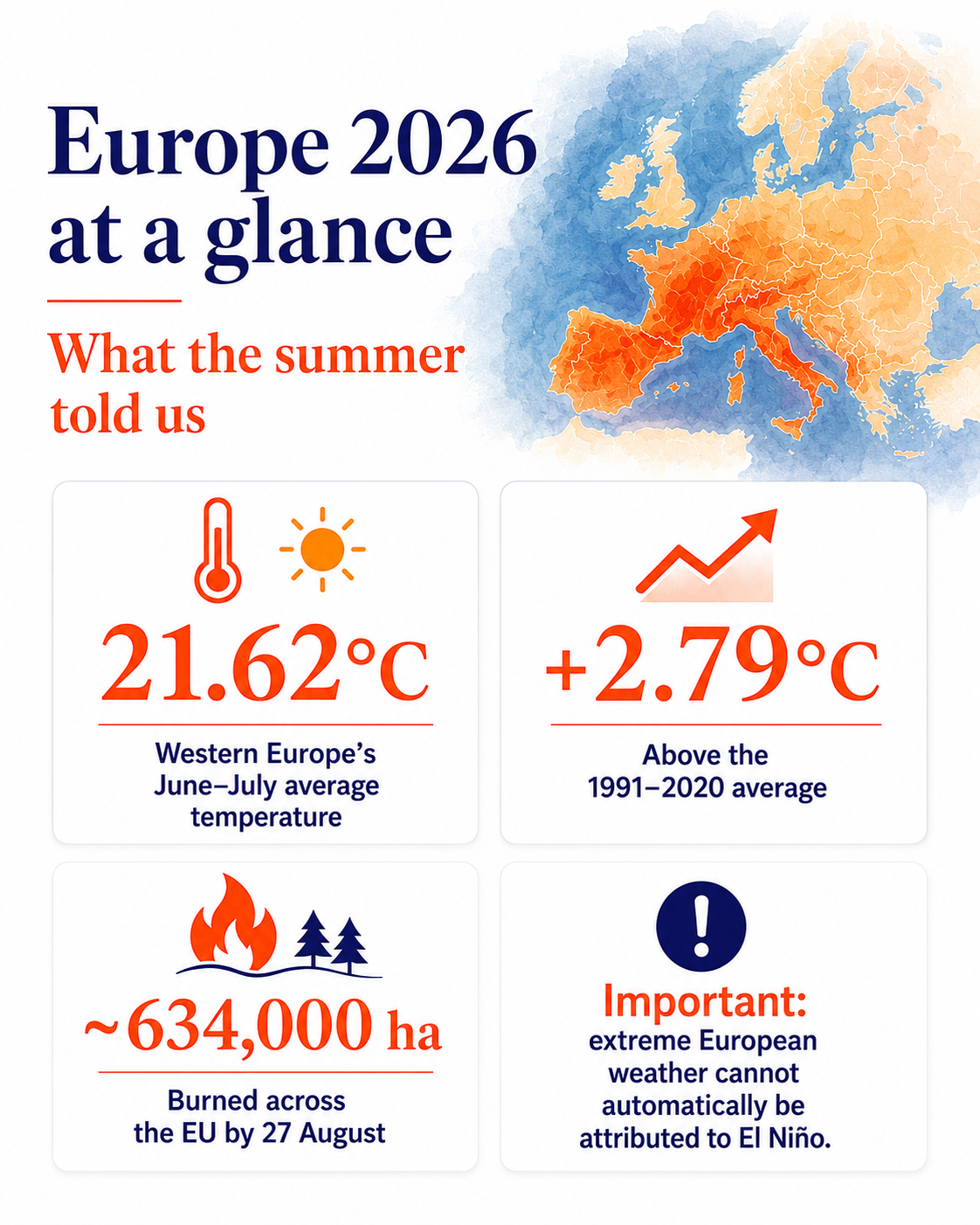
By August 2027, the European Forest Fire Information System had recorded around 634,000 hectares burned across the European Union in 2026, approximately twice the average burned area for the same stage of the year between 2006 and 2025. That does not mean El Niño caused Europe’s summer. Copernicus points to persistent high-pressure systems, dry soils and exceptionally warm conditions as major factors. El Niño is part of the wider climate system, but it is not a convenient explanation for every extreme event.
I actually think making that distinction strengthens the climate argument. We do not help anyone by blaming every fire or drought on El Niño. We help by being honest about what science can and cannot tell us.
Portugal
The same caution applies here, in Portugal. According to IPMA, El Niño's influence on mainland Portugal is relatively weak and indirect when compared with places such as South America or Australia. Portuguese weather is much more directly influenced by atmospheric circulation over the North Atlantic.
So if Portugal experiences another major wildfire or heatwave, saying immediately that “El Niño caused it” would be misleading. What we can say is that these variations are now happening in a world that is becoming warmer. And that changes the starting point.
Did Humans create el niño?
The correct and simple answer to this question is: No. Climate change did not create El Niño; it is a natural part of Earth’s climate system and existed long before industrialisation. Scientists are still studying exactly how global warming may affect future El Niño events, and the IPCC (Intergovernmental Panel on Climate Change) does not simply conclude that every El Niño will automatically become stronger.
What is much clearer is that humanity has changed the background climate in which these events happen. A warmer atmosphere can hold more moisture. Heat extremes can become stronger, dry periods can become more damaging, and heavy rainfall can become more intense. The IPCC also expects ENSO-related rainfall variability to increase as global temperature rises.
So, let’s put it this way: El Niño is the wave, and climate change is raising the water underneath it. We did not create the wave, but we are changing the conditions in which it arrives.
Can we actually fight it?
We can’t stop El Niño, nor would it make much sense to try. It is part of the natural climate system.
What we can change is how vulnerable we are when it happens. Experts can often identify developing El Niño conditions months in advance, giving governments, farmers and humanitarian organisations something incredibly valuable: time. Water supplies can be prepared, and planting decisions can change. Drought-resistant seeds can be distributed. Drainage systems can be cleared. Emergency services can prepare, and communities can receive warnings. Ahead of the 2023-24 El Niño, the Food and Agriculture Organisation carried out anticipatory action in 24 countries, reaching around 1.7 million people before many of the expected hazards had fully developed.
The logic is simple. If we know a farmer is likely to lose a crop, helping before that crop fails makes more sense than arriving afterwards with emergency food. Early-warning systems follow the same principle. According to the World Meteorological Organisation, countries with weaker warning systems suffer disaster mortality rates several times higher than those with strong systems. Even 24 hours of warning can significantly reduce potential damage.
Sometimes climate adaptation does not require science fiction; sometimes it simply means being prepared early enough.
If temperatures continue rising, we cannot simply build larger flood barriers, buy more firefighting aircraft and install more air conditioners forever. We also need to reduce the warming underneath the problem.
That means cutting greenhouse-gas emissions, expanding cleaner energy, improving efficiency, reducing methane emissions and protecting natural ecosystems. This is where climate communication can become unfair. We tell people to recycle, switch off lights and use reusable bottles until the climate crisis starts sounding like the personal moral failure of an individual consumer. It isn’t. Energy systems, transport, agriculture, industry and political decisions determine enormous parts of our emissions.
But I also do not believe the opposite argument that one person is too small to matter. We are not only consumers. We are voters, workers, students, parents, investors, and members of communities. One person’s action may seem insignificant, but millions of people changing what they demand, support, and vote for is something completely different.
And the solution? Sometimes the planet has already built part of the solution itself. Forests retain water, wetlands absorb floods, mangroves protect coastlines. Healthy soils retain moisture, and vegetation helps cool cities. Yet we often remove protections, destroy forests, cover land in concrete, and build over floodplains, only to spend enormous amounts trying to replace what was already there. UNEP supports ecosystem-based adaptation projects around the world precisely because restoring forests, wetlands, and mangroves can make communities more resilient. This does not replace reducing emissions, but it reminds us of something simple: sometimes helping the planet does not mean inventing something new; it means allowing existing natural systems to keep doing their job.
Does environmental action actually works?
One of the clearest recent examples is the global response to the Covid 19 pandemic. Scientists identified a new virus, researchers developed effective vaccines in record time, governments introduced public-health measures, and vaccines adapted their operations to reduce transmission and protect workers. The response was imperfect, uneven and often politically divisive. But it showed that societies can absorb complex scientific information, coordinate across borders, change behaviour and redirect enormous industrial capacity when the risks become impossible to ignore. It did not happen because everybody suddenly became a public- health expert. It happened because science identified a problem, people paid attention, governments acted, and industry adapted.
Of course, COVID-19 was a public health crisis, not an environmental one. It proves that large-scale action is possible, but it does not answer the question in the title. So, does environmental action itself actually work?
We have some pretty convincing evidence that it does. One of the clearest is the Montreal Protocol. In the 1980s, scientists realised that chemicals used in refrigerators, aerosols and other products were destroying the ozone layer. Governments eventually agreed to phase them out, and industries had to find alternatives. Today, nearly 99% of controlled ozone-depleting substances have been phased out globally, and if current policies remain in place, the ozone layer is expected to return to roughly 1980 levels around 2040 across most of the world, around 2045 in the Arctic and around 2066 over Antarctica. The story did not end there. Some of the substances introduced as replacements, particularly hydrofluorocarbons (HFCs), did not damage the ozone layer but created another problem: they are powerful greenhouse gases, with some capable of trapping thousands of times more heat than carbon dioxide. So in 2016, countries went back to the same agreement and adopted the Kigali Amendment to the Montreal Protocol. Instead of pretending the original solution was perfect, they adapted it. The amendment requires countries to gradually reduce the production and consumption of high-warming HFCs by more than 80% over the following decades. It entered into force in 2019 and, if fully implemented, is expected to avoid around 0.3ºC to 0.5ºC of global warming by the end of this century.
I think this might actually be one of the most useful environmental examples we have. We discovered one problem, acted on it, realised that part of our solution had created another and acted again. That is not environmental policy working perfectly. It is environmental policy learning.
And this is not the only case,
Costa Rica spent decades trying to reverse one of the most serious deforestation problems in the world. Through protected areas, payments to landowners for conserving forests, and broader environmental policies, the country managed to reverse the trend. Forests now cover nearly 60% of its territory, according to the World Bank. That does not mean Costa Rica solved every environmental problem it has, but it does show that long-term policy can actually restore something that had already been badly damaged.
If we want to share examples about Europe, we also have them. Acid rain once became one of the major environmental concerns across the continent because of sulphur pollution released mainly by industry and power generation. In 1984, around 40 percent of the natural environment was affected by acid deposition that exceeded the critical load. Governments introduced stricter limits, technologies changed, and cleaner fuels gradually replaced more polluting ones. By 2022, sulphur dioxide emissions across the European Union had fallen by 81% compared with 2005.
Even with greenhouse gases, where we are obviously nowhere close to saying the problem has been solved, there has been measurable progress. Between 1990 and 2024, the European Union reduced its net domestic greenhouse-gas emissions by around 40%, while its economy grew by more than 70%. The European Environment Agency links much of that reduction to cleaner electricity, energy efficiency, lower use of carbon-intensive fuels and climate policies introduced over the past decades.
There are smaller, more targeted victories as well. ClientEarth and Greenpeace Romania spent years challenging Romanian coal plants that were operating without adequate environmental permits. Their legal action contributed to European Commission infringement proceedings, changes in Romania's pollution law, stronger penalties, and the shutdown of several targeted coal units.
That said, none of these examples mean the environmental action always works, or that every policy succeeds. Sometimes governments move too slowly, industries resist, policies fail, or the damage is simply too large to reverse quickly. But I think they do answer the question. Environmental action works when concern becomes something concrete: law, policy, investment, technology, enforcement, and people actually changing the way things are done.
Of course, there’s no need for me to say that there is another side to this which is probably just as important. Environmental progress is not permanent simply because we managed to achieve it once. The United States is a very current example: President Donald Trump ordered the country to withdraw again from the Paris Agreement in January 2025, with the withdrawal formally taking effect on 27 January 2026. His administration has also reversed or weakened several climate policies, including federal greenhouse-gas standards for vehicles, while arguing that previous rules imposed high costs, restricted consumer choice, and harmed American energy production. In February 2026, the Environmental Protection Agency also rescinded the 2009 Endangerment Finding, which had provided the legal basis for federal greenhouse-gas regulation of motor vehicles.
Whether someone agrees with those decisions or with the economic perspective behind them, they demonstrate that environmental progress can move in both directions. The Montreal Protocol worked because governments maintained cooperation over decades and even updated the agreement when new problems appeared. Climate action therefore does not only depend on finding solutions, but it also depends on societies continuing to choose them.
What do we actually do?
It is easy to talk about climate change in abstract terms, but that does not always help people understand what they can do with the information. A more useful place to start is with the choices and responsibilities that exist in everyday life, from the organisations we support to the politicians we vote for and the communities we help prepare for what is coming.
What probably makes more sense is to ask what each of us can realistically do and where that action can actually have some effect.
There are different ways to contribute, and they do not all require the same amount of time, money or energy. You can support organisations that are transparent about their work and its results, volunteer with a local group, share reliable information or simply talk to people around you. Even small forms of support can be useful when they are realistic and consistent. There is no single correct way to contribute; it comes down to what we have to give.
The same applies to donations. Is it worth asking where the money goes, reading the reports, understanding what the organisation has already achieved, and whether the work is having the kind of impact it claims to have? If we are going to ask people to care about climate change, then we should also be serious about where that concern is directed.
Politics is another obvious part of this, even if people do not always like to connect the two. And maybe, the next time while choosing, learning, or trying to figure out who you’re going to vote for, ask yourself: what’s their plan for a hotter Portugal? How do we prepare for larger and more difficult wildfires? How do our cities deal with extreme temperatures, and what happens to people who cannot simply have air conditioning, move somewhere safer, or rebuild everything after a disaster?
That is probably one of the things we need to understand better; climate change is no longer a separate environmental issue that we can leave to experts or scientists or environmental organisations. It affects food, housing, energy, health, transport, jobs and the way cities are built. Eventually it reaches almost every part of normal life.
El Niño will happen again, and so will La Niña. After that, there will eventually be another El Niño, because we cannot stop the Pacific Ocean from behaving like the Pacific Ocean. What we can influence is the condition of the planet each new cycle arrives in and how prepared we are when it does.
The frustrating part is that we already know quite a lot about what helps. Early-warning systems save lives, healthier ecosystems protect communities (either human or wildlife), cleaner energy exists, emissions need to fall, and preparing before disasters happen is more effective than only reacting afterwards. We also have examples showing that governments, industries and societies can actually change direction when the pressure becomes strong enough. So maybe the real difficulty is no longer understanding what needs to be done. It is deciding whether we are willing to treat it with the seriousness we already give to other crises once they become impossible to ignore.
The Planet will continue changing whether we are ready or not, and perhaps the question is not whether we can stop every consequence, as if we are superheroes, because we cannot. It should be whether we are willing to become better at preparing, reducing, and acting before the next disaster forces us to care.