
Who actually runs Europe
By Rodrigo Ferreira
Europe through the things democracy needs
The European Union has seven institutions, thousands of employees, several presidents, two different Councils, and enough acronyms to make almost stop reading before understanding who actually does what.
That is unfortunate, because decisions taken at the European level eventually reach places that feel considerably less distant than Brussels, Strasbourg, Luxembourg, or Frankfurt. They appear in the products we buy, the rules companies follow, the protection of our rights, the value of our savings, environmental standards, and the way national governments spend European money.
So rather than explaining the European Union through another institutional diagram, we wanted to try something different.
Behind all of those institutions are functions that every democracy needs in one form or another: participation, action, compromise, direction, rule of law, stability and accountability.
The EU itself distinguishes between four institutions at the centre of political decision making: the European Parliament, European Council, Council of the European Union, and European Commission. With also three other institutions responsible for judicial, monetary and auditing functions: the Court of Justice, European Central Bank, and European Court of Auditors.
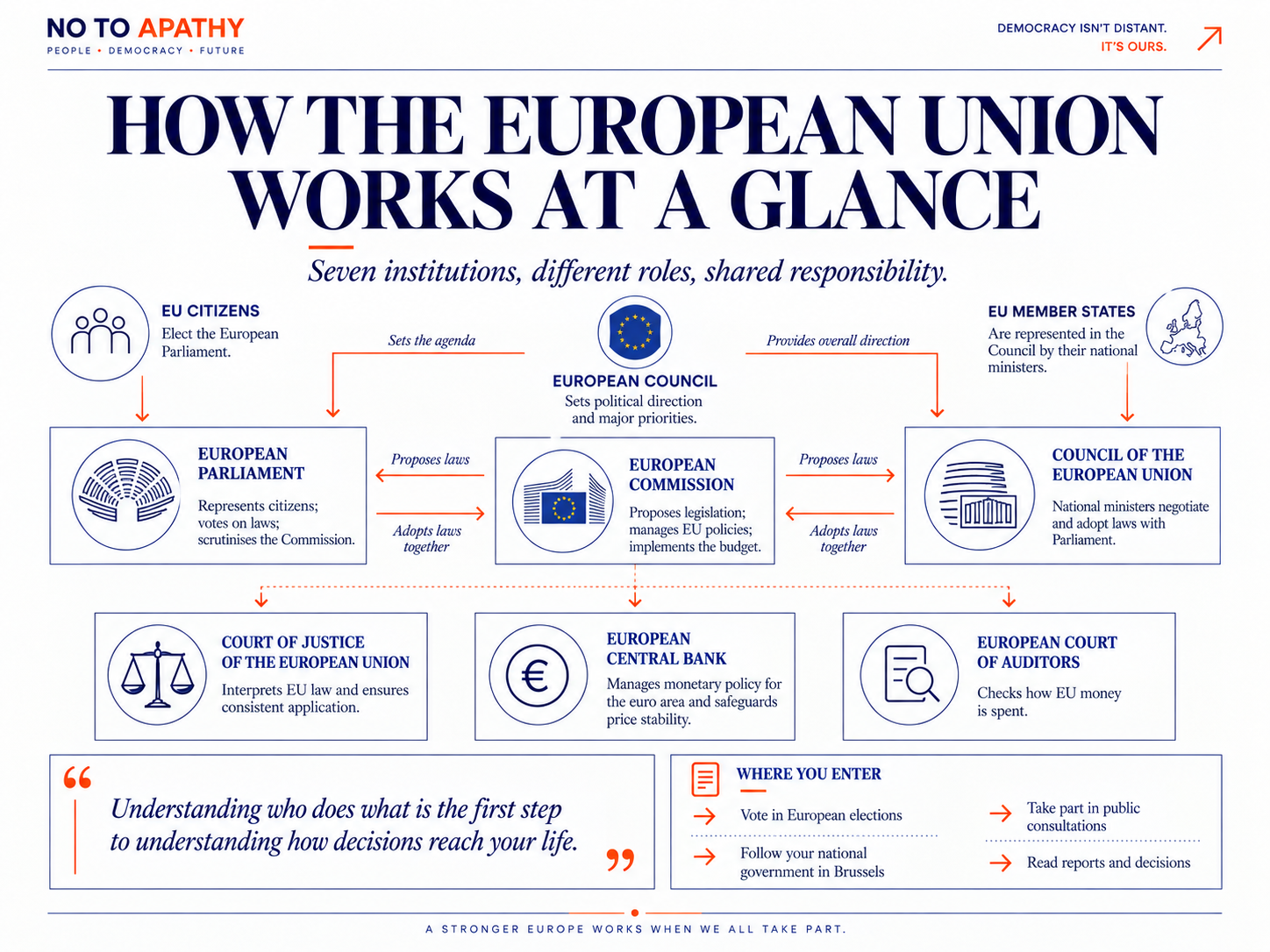
A simplified overview of how the EU’s seven institutions divide responsibilities and interact.
Image created with the help of AI.
Participation→ The european parliament
The European Parliament is probably the most familiar place to begin because it is the only EU institution directly elected by citizens. Since the 2024 European elections, it has 720 members, elected across the 27 Member States.
Its role goes far beyond political debate. On most European Legislation, Parliament acts as a co-legislator with the Council of the European Union. It can amend proposals, negotiate legislation, approve the EU budget and scrutinise the work of other institutions, including the European Commission.
This is why is a useful way of understanding Parliament. European elections do not directly choose a European government in the same way national elections normally choose parliamentary majorities, but they determine who represents citizens inside one of the two institutions that adopt most EU legislation.
Y(our) vote has to go somewhere. At the European level, this is where it goes.
Action→ The european commission
Participation alone does not produce legislation. Eventually, somebody has to take a problem, gather evidence, consult interested groups and turn an idea into an actual proposal.
In most areas of EU law, that role belongs to the European Commission.
The Commission functions as the EU’s executive institution. It proposes new legislation and policies, implement decisions, manages EU programs and the budget, and monitors whether European law is being correctly applied by Member States.
This does not mean the Commission can simply decide what European law will be. In the ordinary legislative procedure, its proposal moves to the European Parliament and the Council, which negotiate and decide whether the proposal becomes law.
There is also a point here where citizens can enter the process much earlier than many people realise. Through the Commission’s Have Your Say Portal, individuals, businesses, public authorities, and civil-society organisations can respond to consultations and give feedback while policies are still being prepared. Contributions can be submitted in all 24 official EU languages.
This is where action starts to make sense as the Commission’s role: turning an issue into something institutions can actually negotiate.
Compromise- the council of the european union
This is where European terminology starts becoming unnecessarily difficult.
The Council of the European Union is not the European Council. The Council of the EU brings together national ministers from all 27 Member States. Which ministers attend depends on what is being discussed: finance ministers for economic questions, the environment minister for environmental policy, agriculture ministers for farming, and so on.
Together with the Parliament, the Council negotiates and adopts most European legislation.
Europe is not one country, so agreement often requires governments with very different political priorities to find a common position. The Council therefore uses different voting systems depending on the subject. Qualified majority is the most common and is used for around 80% of EU legislation; under this system, approval normally requires at least 55% of Member States at least 65% of the EU population. Some sensitive areas still requires unanimity.
This is where compromise becomes more than a nice political word.
direction→ the european council
Then we have the European Council, which brings together the heads of state or government of the Member States, along with its own President and the President of the European Commission.
Its function is different from the Council of the EU because it does not normally negotiate or adopt legislation. Instead, it defines the union’s broad political direction and priorities.
When European leaders meet to discuss subjects such as security, enlargement, migration, competitiveness or major international crisis, this is often the institution involved.
The easiest distinction is probably this: the Council of the European Union helps decide what laws should look like, while the European Council deals much more with where Europe should be going politically.
Rule of law→ The court of justice of the eu
Making rules becomes fairly meaningless if those rules mean something completely different depending on which country happens to be applying them.
The Court of Justice of the European Union, based in Luxembourg, exists to interpret and enforce EU law and ensure that it is applied consistently across the Union. The institution itself includes the Court of Justice and the General Court.
National courts can ask the Court of Justice questions about how European law should be interpreted, while the Court can also review the legality of EU acts and deal with situations in which Member States or institutions are accused of failing to respect their obligations under EU law.
Its decisions have affected areas ranging from equal treatment and consumer rights to healthcare and air-passenger protection.
Stability→ The european central bank
When talking about the European Central Bank, its responsibilities apply primarily to the euro area, rather than every EU country.
The European Central Bank, from now on ECB, manages monetary policy for the countries using the Euro, which currently means 21 countries and around 358 million people. Its primary objective is maintaining price stability, which the ECB currently defines as aiming for 2% inflation over the medium term. This sounds extremely technical until interest rates change.
Then mortgages change, borrowing becomes more or less expensive, savings behave differently, and the broader economy reacts. For many people, the ECB can seem distant or overly technical, until its decisions start showing up in everyday life through higher mortgage payments, changes in borrowing costs or the way inflation affects what we can buy.
Its place in this article is therefore stability, because monetary policy is one of the mechanisms designed to keep the currency and the wider euro-area economy operating within relatively predictable conditions.
Accountability→ the european court of auditors
Finally, somebody has to follow the money.
The European Court of Auditors is the EU’s independent external auditor. Despite its name, it is not a court that sentences people. Its role is to examine European revenue and spending, check whether funds are being managed according to the rules, and assess whether programs are delivering value for money.
Its reports are used by institutions such as the European Parliament when scrutinising how the European budget has been managed, but they are also available publicly. That makes accountability probably the simplest of the seven ideas to explain: if European institutions spend public money, the public needs mechanisms capable of checking where that money went and what it achieved.
So, who actually runs europe?
The answer is that there is no single institutions that does.
The Commission normally proposes. Parliament represents citizens and legislates. National governments legislate through the Council. The European Council establishes political direction. The Court of Justice interprets the law. The ECB manages monetary policies for the euro area, while the Court of auditors follows European money.
Power is deliberately distributed between institutions representing different things: citizens, national governments, the collective interests of the Union, the law and independent economic or financial oversight.
That arrangement can make Europe difficult to understand, but understanding it also makes something else clearer: “Brussels decided” is very rarely the full story.
In the next parts of this series, we can start opening each institution properly: who sits inside it, how those people get there, how much power they really have, where citizens can intervene and where the system becomes more complicated.
We don’t need to support every decision made by the European Union to understand how it works. But if those decisions eventually reach our everyday life, maybe, knowing who made them, how they got there and who can be held responsible is probably a good place to start.
learn more here
https://european-union.europa.eu/easy-read_en
https://european-union.europa.eu/index_en
https://ec.europa.eu/info/law/better-regulation/have-your-say_en
https://curia.europa.eu/site/jcms/d2_5093/en/the-court-of-justice
https://www.ecb.europa.eu/home/html/index.en.html
https://www.consilium.europa.eu/en/european-council/
https://op.europa.eu/webpub/com/short-guide-eu/en/how-does-the-eu-work.html
https://www.cfr.org/backgrounders/how-does-european-union-work
https://european-union.europa.eu/institutions-law-budget/leadership/presidents_en
