
80 Years of the United Nations: Flawed and Fragile, but Necessary
By Tristan Jose
I think most people have heard of the UN - and have some idea of it’s purpose. It is the largest and most well-known international inter-governmental organisation in the world. According to the UN itself, in 2025 it employed over 120,000 people worldwide across its agencies and programs. We wanted to dig a little deeper and look at its history, what it does and where it is today. We cannot hope to do justice to every success or failure but rather try to offer insights. We invite you to contribute and discuss what we may have missed or where you think we might have gone wrong.
A (very) Short History of the UN
The United Nations was brought to life in 1945 following the devastation of the second world war with its charter coming into force in October of 1945. According to Article 1 of the charter the purposes of the UN are:
To maintain international peace and security, and to that end: to take effective collective measures for the prevention and removal of threats to the peace, and for the suppression of acts of aggression or other breaches of the peace, and to bring about by peaceful means, and in conformity with the principles of justice and international law, adjustment or settlement of international disputes or situations which might lead to a breach of the peace;
To develop friendly relations among nations based on respect for the principle of equal rights and self-determination of peoples, and to take other appropriate measures to strengthen universal peace;
To achieve international co-operation in solving international problems of an economic, social, cultural, or humanitarian character, and in promoting and encouraging respect for human rights and for fundamental freedoms for all without distinction as to race, sex, language, or religion; and
To be a centre for harmonizing the actions of nations in the attainment of these common ends.
It replaced the failed League of Nations which had been established after the end of the first world war. The League of Nations failed for a number of reasons - membership, inability to take action economically or militarily among others. It was dissolved when the UN rose to take its place. How is the UN crucially different from the league of nations?
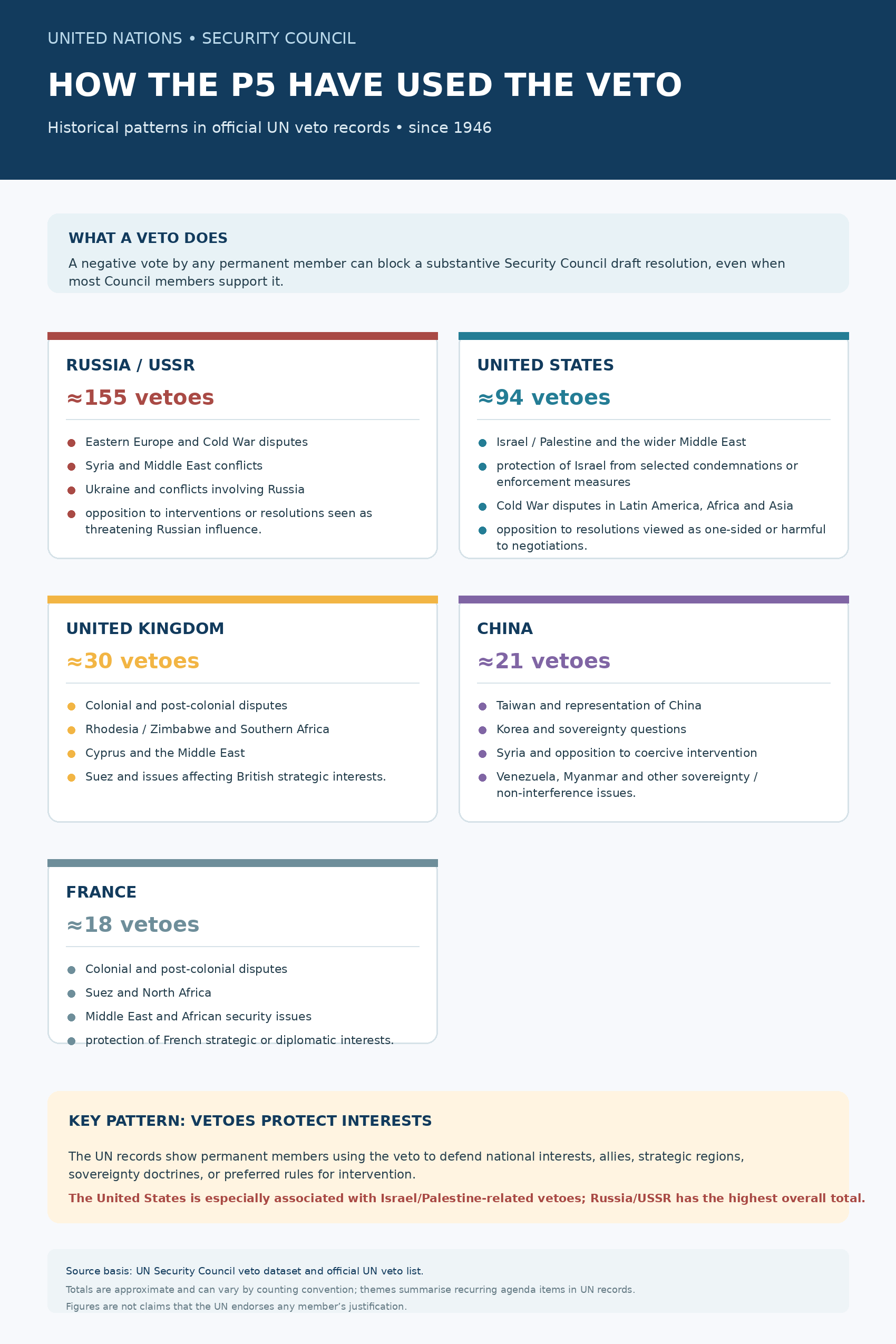
UN Security Council: Its primary responsibility is to maintain international peace and security. It is made up of 15 members, with 5 permanent members (China, France, the Russian Federation, the United Kingdom, and the United States) and 10 members on 2 year rotations elected by the general assembly. Under the UN charter all member states are obligated to comply with security council decisions. However, the permanent members have veto rights - allowing them to prevent any decision from taking effect. This mechanism is meant to avoid large scale conflicts involving superpowers but also shines a light on how powerless the UN is to stop conflicts involving any of its permanent members.
Sanctions: Security Council sanctions can take many different forms, depending on the outcome that the UN wants to achieve. The measures have ranged from comprehensive economic and trade sanctions to more targeted measures such as arms embargoes, travel bans, and financial or commodity restrictions. Since 1966, the Security Council has established 31 sanctions regimes (though none against any permanent security council members given their veto rights, despite their involvement in and initiation of many global conflicts).
Peacekeeping: Unlike the League of Nations the UN is able to provide a military presence (provided by certain member states) to support peacekeeping efforts. United Nations Peacekeeping began in 1948 when the Security Council authorized the deployment of UN military observers to the Middle East. And while it has this important tool at its disposal - the reality of how effectively it has been used is a story of mixed outcomes. The number of peacekeepers currently encompasses over 110,000 military, police and civilian staff serving in peacekeeping missions.
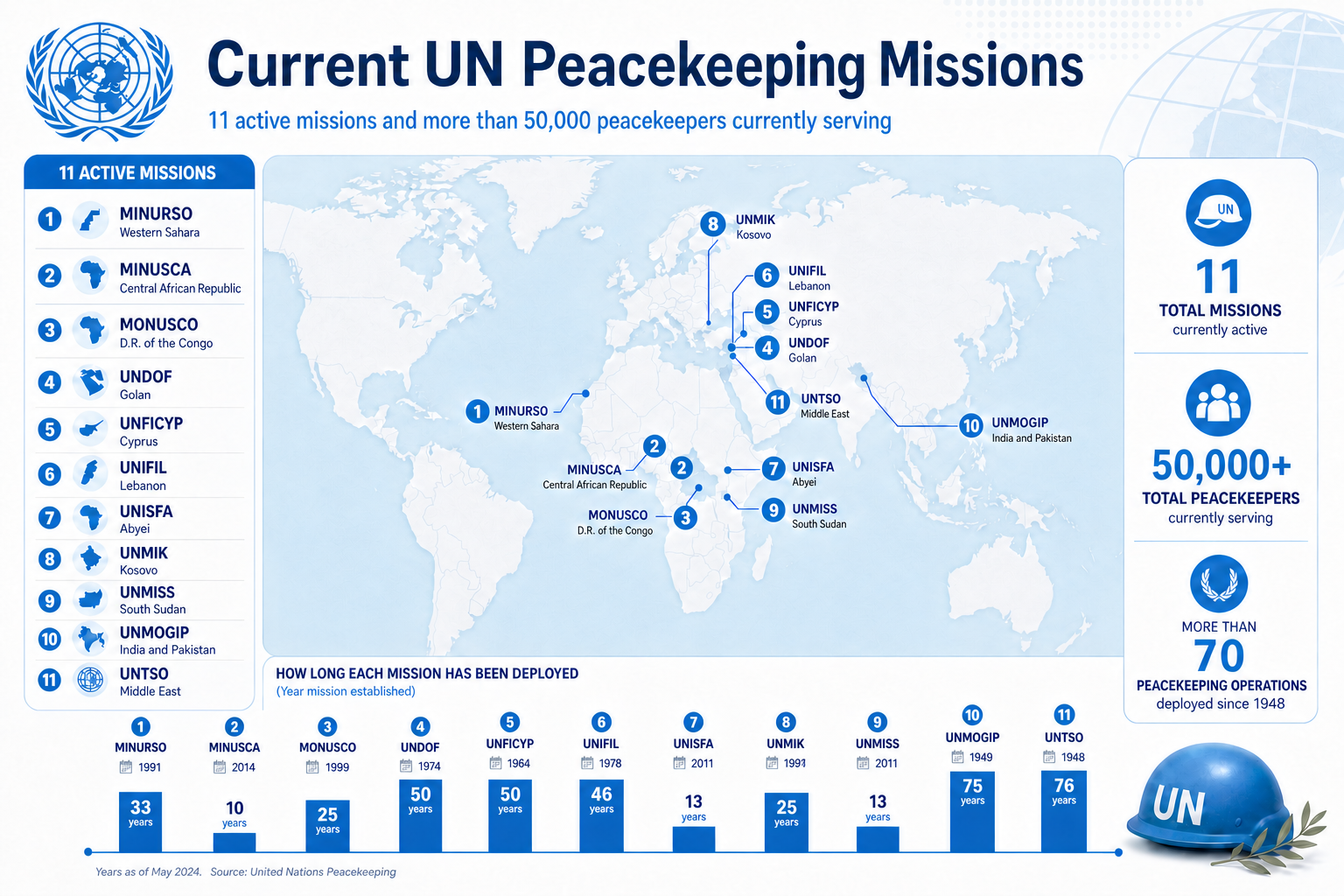
Generated with the help of AI
Compared to the League of Nations, the UN has outlasted its predecessor by a big margin - celebrating 80 years last year. After nearly a century what has the UN delivered on, where has it succeeded and brought about tangible lasting change; and where has it fallen short and undermined trust in it as a global institution?
Notable UN Achievements
Prevention of World War 3: While there has been no lack of conflicts and wars since the Second World War, with countless suffering and destruction - the world has not slipped into another global conflict. A large part of that can be attributed to the UN and the diplomatic, rules based order it has helped to create. The efforts of peacekeeping and conflict containment are also an attributing factor, reducing the risk that regional conflicts escalate. So yes the UN can claim its contribution to the avoidance of a global conflict at devastating scale over its 80 years existence.
Global Rules Structure & Human Rights: The UN through its charter and landmark agreements has created a global framework for cooperation, mediation and the protection of human rights. While the structure of the security council means that certain states can act with near impunity (more on this in a moment), it has created an international standard that provides diplomatic channels, protection and punitive tools. The Universal Declaration of Human Rights (1948) formed the foundation for human rights treaties, regional frameworks and legislation. The UN formed the human rights council in 2006 and creating international standards for human rights and dignity should be seen as one of the greatest achievements of the UN. The UN has also been the driving force behind much more international legislation protecting human rights - how many are you aware of?
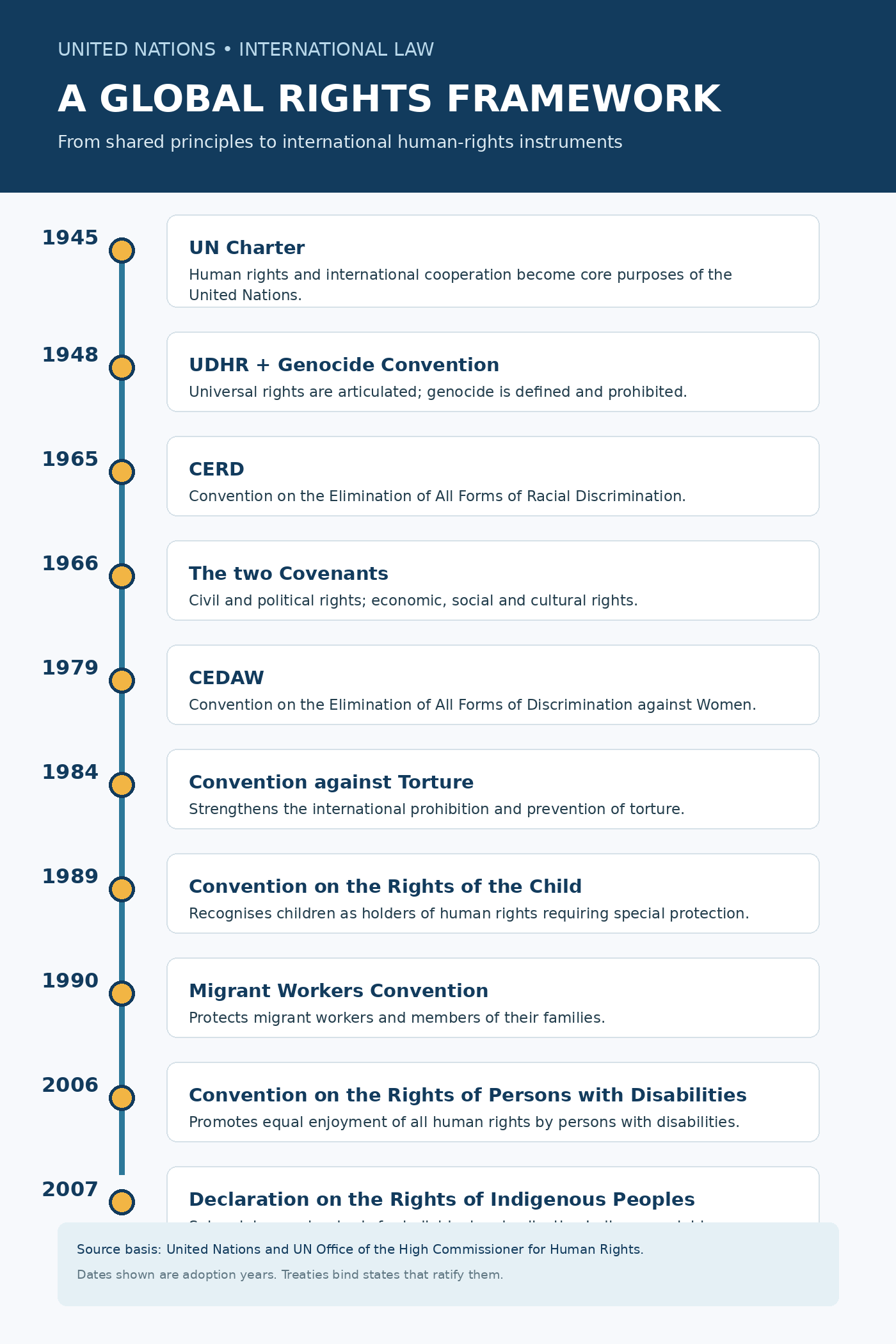
Generated with the help of AI
Decolonization: The UN charter established self-reliance and independence as globally recognized principles. While it did not directly enable the freedom of states oppressed by colonial powers, it did act as a catalyst in changing perspectives and providing legitimacy to newly independent countries. On the 14th of December 1960 the UN General Assembly adopted the declaration on the Granting of Independence to Colonial Countries and Peoples and established the Special Committee on Decolonization the following year. While it lacked the teeth to enforce decolonization efforts, it can definitely be argued that the UN acted as a catalyst and a validating force.
Economic & Social Progress: It is impossible to attribute overall outcomes to specific policies and interventions from the UN. Through its Millennium Development Goals and Sustainable Development Goals the UN has definitely played a critical role as a coordinator, standard setter and funding provider in some of the impressive progression we have seen. But let’s look at some of the outcomes stated by the UN on its Millennium Development Goals (bear in mind we can’t attribute it all directly to the UN when so much depends on national implementation and policies, other organizations and economic growth).
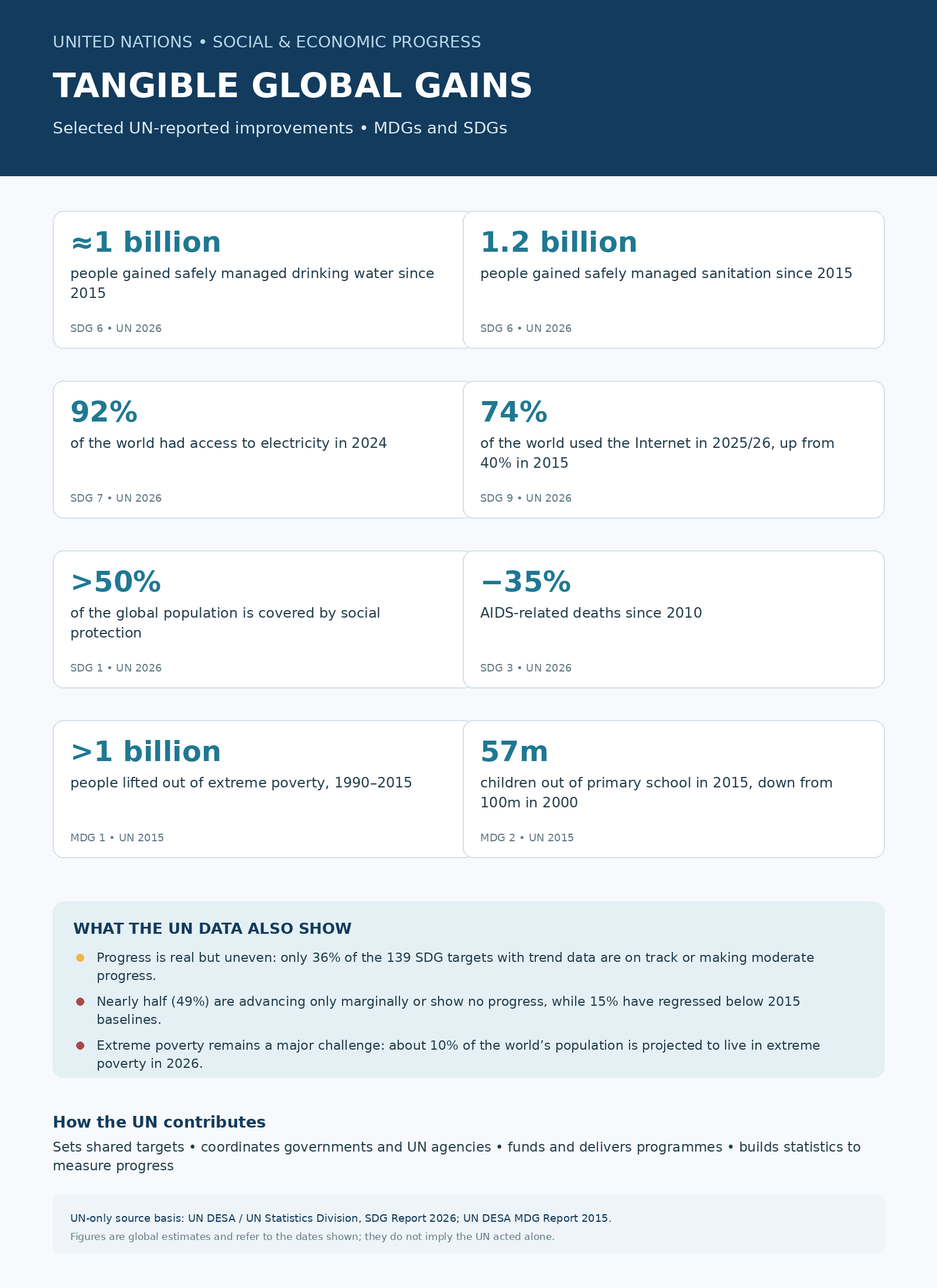
Generated with the help of AI
Humanitarian Relief: Perhaps one of the areas we (rightly) associate most with the UN. Much like the other points raised the picture is nuanced and complex. Did the way certain humanitarian relief was structured harm societies long term as much as it helped people short-term for example? Putting that to one side - The UN plays a crucial role in coordinating responses to emergencies and in supporting rapid humanitarian response for people affected by natural disasters and armed conflict. The UN Refugee Agency (UNHCR) plays a huge role in refugee support - did you know that there are over 40 million refugees worldwide (most - 68% - hosted by low and middle income countries). Since its beginning, The United Nations Children's Fund (UNICEF) has tried to reach as many children as possible. UNICEF has provided vaccinations to nearly half the worlds young children, provides safe drinking water, nutrition support and education.
Painful UN Failures:
Genocides and Crimes against Humanity:
In 1994, in just 100 days, between 800,000 and 1 million people lost their lives in Rwanda in a horrific genocide that was targeted at the Tutsi population. Shortly after the violence erupted the UN reduced its peacekeeping force after the core of the peacekeeping troops were withdrawn by Belgium. This was following the torture and death of ten of its peacekeepers. At a time when peacekeeping efforts should have been ramped up rather than reduced. It represents a point where the UN failed systematically at multiple levels and did not fulfill its mandate. The UN has formally acknowledged its failure.
In 1993, Srebrenica (Bosnia and Herzegovina) was declared a UN “safe area” under Security Council Resolution 819. In July 1995, Bosnian Serb forces captured the enclave and murdered approximately 8,000 Bosniak men and boys while approximately 30,000 women, children, and elderly people were forcibly transferred. Former UN Secretary-General Kofi Annan later declared: "The tragedy of Srebrenica will forever haunt the history of the United Nations."
Israel invaded Gaza in 2023 in response to attacks by Hamas in southern Israel which saw over 1,000 people killed and 240 taken hostage. Since its war in Gaza, Israel has killed over 70,000 Palestinians and destroyed nearly 90% of the Gaza strips infrastructure. Each time the UN Security Council has held a vote to enable a ceasefire in Gaza, the US (as a permanent Security Council member with a Veto) has vetoed and blocked all ceasefire resolutions.
Since 2023, Sudan has also been embroiled in a horrific civil conflict between the RSF and the military with over 14 million people displaced and tens of thousands killed. Amnesty International has outlined that crimes against humanity have been committed with the mindless murder of civilians and a lot gender violence. You can sign Amnesty Internationals petition to the UN security council for an arms embargo to contribute to the protection of civilians here. The UN’s International Court of Justice (ICJ) dismissed Sudan’s case against the UAE (for arming and funding the RSF), saying it lacked jurisdiction, and ultimately rejected Sudan’s request for emergency measures and removed the case from its docket. Will the UN sit on the sidelines once again and watch another genocide unfurl?
In 2018 the UN confirmed that more than a million ethnic Uighurs were detained in ‘counter-extremism’ camps in China with another estimated 2 million in ‘re-education’ centers. In 2022, the UN Human Rights Office released a report which outlined that China’s detention of Uighurs and other (predominantly Muslim ethnic) minorities may amount to “crimes against humanity”. However, once again, with China holding a permanent seat on the Security Council with veto powers - there is little the UN can do.
Peace & Conflict Failures: The list above is by no means exhaustive and complete and we do not want to seem to dismiss the suffering of so many others and other failures of the UN to maintain peace and prevent conflicts and human suffering: The horrific circumstances for the Rohinga in Myanmar or Azerbaijan’s military offensive. The failures in Somalia and Angola. The world faces countless power hungry despots, deranged military leaders and people brimming with unwarranted hate. The UN is constrained by the limits imposed on it when it was founded - but it could also be doing much more and act far more decisively in many situations.
Corruption: There is documented evidence which shows that there are problems of corruption at different levels of the UN and across different agencies. It would be surprising if that were not the case and the UN has directed resources in facing up to problems around corruption. The scale can be quite surprising. A UN Task force reported in 2007 that they had discovered more than 10 significant fraud and corruption schemes in cases with an aggregate value of approximately $610 million, involving misappropriation of $25 million. This led to disciplinary and criminal convictions as well as changes to oversight procedures. There are many other cases involving specific individuals and programs - but these are only the cases that have been brought to light and the question remains how much corruption is still unknown or ignored.
The Haiti cholera outbreak is an example of UN negligence, where it refused to accept accountability and showed extremely poor judgement and decision making. The epidemic began in October 2010, after UN peacekeepers from Nepal were deployed to Haiti following an earthquake. Investigations found that sewage from the UN peacekeeping base entered a tributary of the Artibonite River. The river was an important source of water for local communities, and the outbreak introduced cholera to Haiti for the first time in modern history. Over 10,000 people died as a result and a further 800,000 were infected. We have summarized the findings of Professor Philip Alston, Special Rapporteur on extreme poverty and human rights:
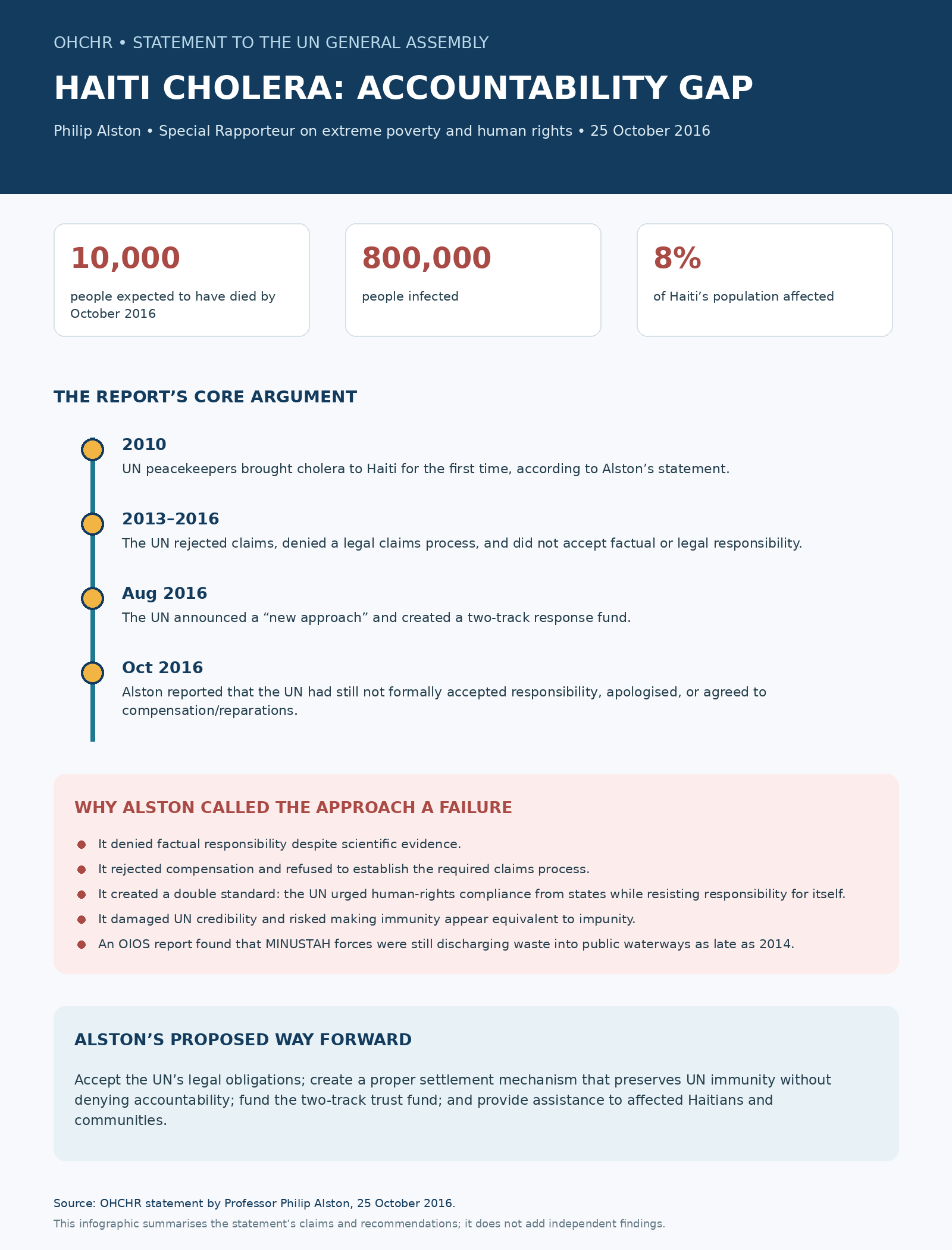
Generated with the help of AI
Challenges faced by the UN:
Institutional & Structural Reform: The UN has failed to evolve and is caught in a trap of structures that reflect the global balance of power following the second world war (1945) and prevent it from acting decisively in many situations. The veto power of permanent security council members effectively allows those states and their allies to act with impunity without fear of sanction and places other states at their mercy. How can entire continents like South America and Africa have no representation as permanent members in the security council? Should there even be permanent members of the security council, or should the council rather rotate temporary membership? Should the General Assembly of the UN have greater powers? One thing is certain - the current structure is failing and abused by certain members. Some progress and commitments were made in the 2024 Pact for the Future, but reform of the security council and veto powers is dependent on the vote of permanent security council members - and do you see them willingly relinquishing power?
The speed of decision making and bloated organizational structures are also a challenge. However, there is progress being made in the right direction. The main current reform program is the UN80 Initiative, launched around the UN’s eightieth anniversary. Its objectives are to simplify the system, reduce duplication, strengthen mandate discipline, and improve delivery to countries and communities. Measures reported in May 2026 include a reduction in certain posts/positions, streamlining teams, digital hubs and more.
So the UN is undertaking significant reforms, especially through UN80. It is consolidating administration, reviewing mandates, improving data-sharing, redesigning country teams, and exploring structural changes.
However, arguably, some of the most important reforms - Security Council representation, veto power, reliable funding, stronger peacekeeping authority, and accountability for serious institutional failures - depend on member states (especially permanent security council members) changing the political rules and structures of the UN and bringing it into the modern and global age.
Generated with the help of AI
Funding: The UN’s funding problem has reached a point of crisis. The UN started 2026 with approximately $1.6 billion in unpaid assessments. As of this year, UN records showed approximately $2.8 billion in unpaid regular-budget assessments, $3.5 billion in unpaid peacekeeping assessments, and $91 million in unpaid tribunal assessments. $6.4–6.5 billion outstanding overall. Is this a weapon or lever used by the most powerful states to leverage the actions and results they want from the UN? How can permanent security council members be allowed to fail to deliver funding and at the same time exercise their veto power and withdraw from organizations like the International Court of Justice? But what is the alternative?
So the UN is facing perhaps one of its most critical periods in its 80 year history. Hamstrung by powerful actors and facing a financial and institutional crisis. But is the world a better place for having the UN in it? My personal answer would be an unequivocal and resounding YES. It has failed and stumbled horrifically at times - with a cost written in blood and suffering but where would we be without it? What can each of us do as individuals to support the UN?
How can you be involved?
Volunteer: Sign up for virtual or onsite roles through UN Volunteers to offer professional or community skills.
Donate: Provide direct financial support to key bodies like UNICEF, UNHCR, or the World Food Programme.
Advocate: Promote the Sustainable Development Goals (SDGs) in your daily life, workplace, and local community.
Inform: Share accurate information and human rights principles from official UN channels to fight misinformation.
Further Reading:
https://unsceb.org/statistics/hr-duty-station/
https://www.un.org/en/about-us/un-charter
https://main.un.org/securitycouncil/en/content/current-members
https://main.un.org/securitycouncil/en/sanctions/information
https://www.theguardian.com/world/2015/sep/07/what-has-the-un-achieved-united-nations
https://www.un.org/en/chronicle/article/protection-human-rights-under-universal-international-law
https://www.un.org/development/desa/en/news/statistics/mdg-report-2015.html
https://www.bbc.com/news/world-europe-53346759
https://www.amnesty.org/en/petition/demand-an-arms-embargo-in-sudan/
