
FIFA: The Football Syndicate
By Tristan Jose
In all honesty I have never been a massive football fan. The world cup was always another story, arguably the most anticipated sporting event across the globe. National pride on full display, underdogs like Cabo Verde rising to fame in a brilliant way and a time for fun, solidarity and diversion. Dare to sneak a peak behind the curtains though and you are sure to be left with a sour taste in your mouth.
FIFA has cemented its monopoly over world football - any arguments? No? Okay then - but how is it that it can be both one of the biggest multinationals in the world with hundreds of millions in income every year AND an NGO (registered in Switzerland) paying minimal tax? How can an organisation bend states and countries to its will? This is the point where I could drift into pages of detail but for now I will just highlight a couple of points instead:
Corruption: FIFA cannot shake its corrupt image - a point brought home by the U.S. criminal investigation in 2015 that saw 7 senior officials charged with taking bribes over 150 Million USD over 20 years. An ethics probe and its subsequent report by a former US attorney general deemed its organisation culture to be founded on greed, secrecy and corruption. Their decision in the current world cup to lift the the ban on US star Balogun after a phone call from Trump does nothing to change this image.
Human Cost: The world cup in Qatar was controversial enough before we consider the loss of human life. The number of migrant workers that lost their lives in building the infrastructure for that folly are impossible to know for sure. Estimates range from 37 (Qatari Government) to thousands. All we can say for sure is that the event and the world cup was stained.
I could keep going and talk about affordability and access. Or how FIFA has its head so far up Donald Trumps sizeable ass that it offered the man who threatened his allies, went to war with Iran, bullied Cuba and kidnapped a president its frankly ridiculous world peace prize. But it would not be fair to not also mention that there is some good mixed in with the bad - promoting/supporting women’s football, refugee support, education programs and more. Although I think its important to state that on this side of the equation the information is predominantly provided by FIFA itself.
In my opinion FIFA does not deserve to control world football - its time for nations to step up and impose governance, oversight and accountability on the largest monopoly of world sport.
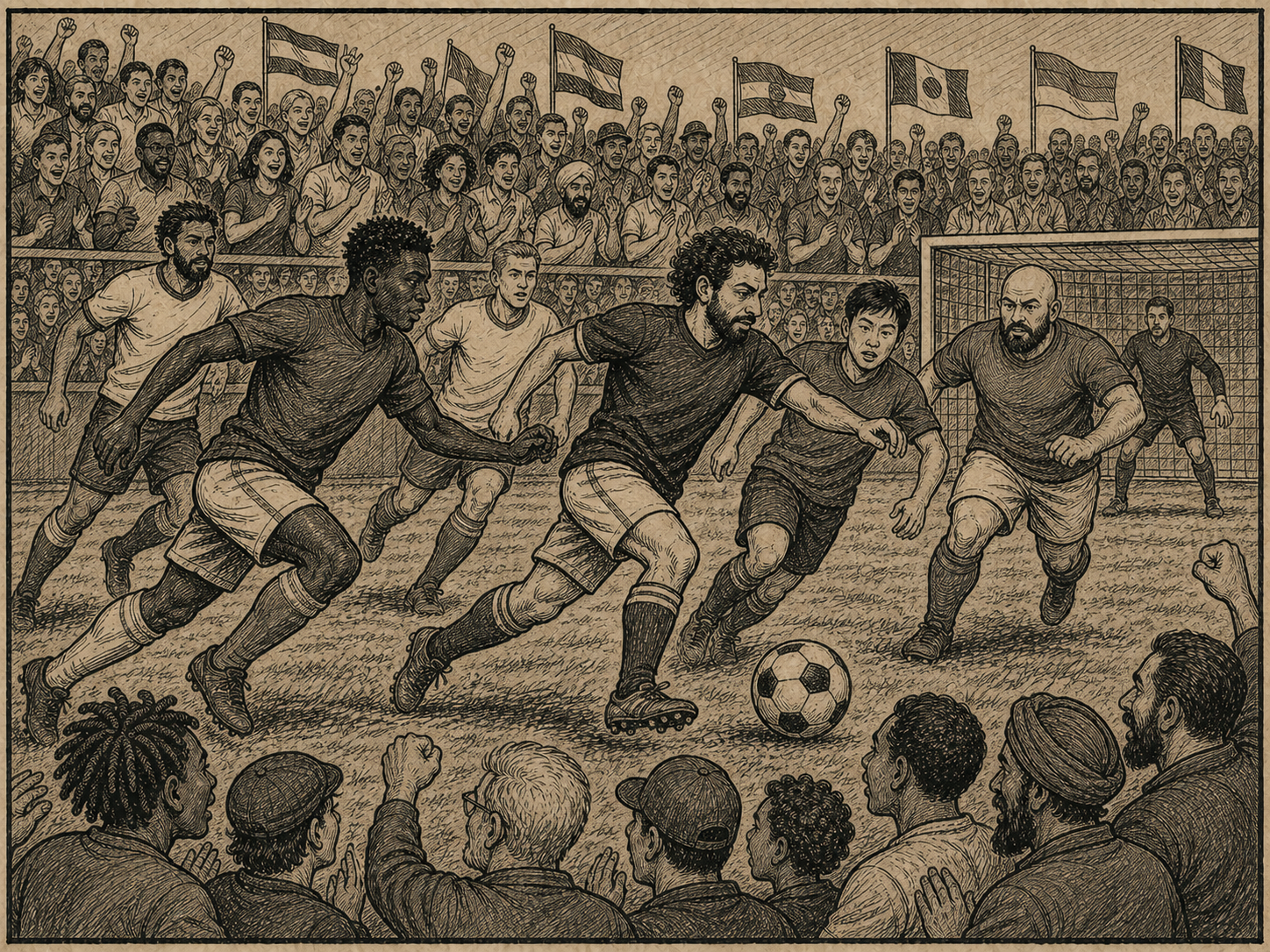
Generated with the help of AI
The Beautiful Game
By Rodrigo Ferreira
Let me begin by saying I’m Tristan’s opposite: I’m hopelessly obsessed with football. Since I was a kid, I’d kick a ball against a wall until my parents or neighbors complained. Nothing compares to the feeling of a last-minute goal—the noise, the chaos, the way a street erupts all at once over a ball crossing a line. Football isn’t merely a sport to me; it’s one of those rare things that makes strangers feel like family for ninety minutes.
Which is exactly why FIFA makes me so respectfully angry.
Before any of the boardrooms, before the broadcasting deals, before a Swiss tax address turned a sport into an empire, football belonged to the people. A ball, a patch of dirt, and two Flip-flops or wooden sticks for goalposts. No entry fee. No sponsor logo. No federation decides who gets to play and who doesn’t. That is exactly where the magic of this sport was actually born, and it is worth saying clearly: it was never born in Zurich.
Somewhere between then and now, the people who actually own this game- the fans, the street players, the kids with nothing but a ball and a dream- got pushed to the very edge of an industry built entirely on their love for it. The money didn’t disappear. It just stopped flowing back to its source.
The thing about loving football the way I do is that you start to notice the gap. The gap between what happens on the pitch and what happens in the boardrooms. The players give everything for ninety minutes of something authentic. And then you look up and realize the people running the whole show haven’t kicked a ball with real stakes in their lives. They are not protecting the game. They are renting it out to whoever pays the most and asks the fewest questions.
Tristan already gave the numbers on corruption and human cost in Qatar. I won't repeat them. I want to discuss what it feels like to watch this as a fan. Ticket prices climb every cycle, wages for stadium builders stay criminal, and broadcasting rights are sold to the highest bidder. Somehow, fans are always an afterthought in Zurich.
And then there is the sportswashing. Watching a tournament get handed to whoever has the most oil money and the least patience for human rights, and watching FIFA dress it up as “growing the game” or “building bridges”, makes my stomach turn every single time. The game is being used as a PR exercise for regimes that would rather you talk about certain players than about what is happening to the people who built the stadium they are playing in. Not even going to start talking about people being prohibited from watching a football match just because of their nationality.
Football, at its core, has always been a working-class sport. A sport for the streets, the favelas, the rough patches of grass with jumpers for goalposts. FIFA does not own that soul. It never did. They just figured out how to put a price tag on it.
If we want football to improve, our main call to action is this: we must love the game enough to keep those in charge accountable. We must stop treating FIFA as an unquestionable authority and instead demand that national federations, players’ unions, and fans recognise FIFA as an organisation that works for us. When that happens, football can become as great as its players deserve.
Further Reading:
https://www.britannica.com/event/2015-FIFA-corruption-scandal
https://www.dw.com/en/fifas-controversial-business-model/a-18479441
https://www.dw.com/en/fact-check-how-many-people-have-died-for-the-qatar-world-cup/a-63763713
